Showing posts with label Orange Research. Show all posts

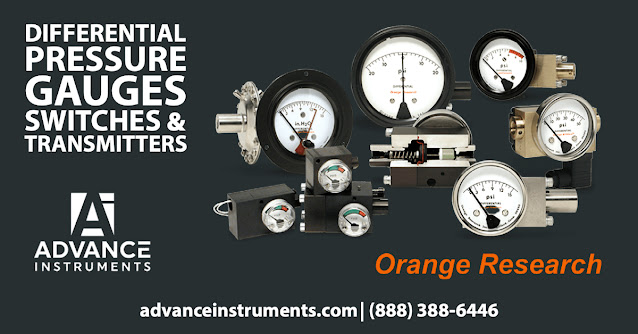
Differential Pressure Gauges, Switches & Transmitters

Differential Pressure Gauges, Switches & Transmitters

Orange Research has built a reputation as a world-leading differential pressure gauge maker for more than fifty years in operation. Their gauges detect the pressure difference between two places in a system and display the resulting differential pressure on a single gauge dial. A magnetic movement permits simultaneous detection of both pressures without using mechanical seals while isolating the differential pressure gauge function from the pressure chamber. 

Unlike regular pressure gauges, different pressure gauges can show minor differential pressure values even at high line pressures. Orange Research offers differential pressure switches using reed switches or relays to initiate alarms, activate other equipment, or shut down a system, in addition to their differential pressure gauge options. Models include two switches when high and low limit control is required. 

Orange Research has created a line of differential pressure transmitters that can also provide data signals. Unique Hall effect sensors in the microprocessor-based devices translate the differential pressure gauges' natural magnetic movements into electric impulses. The DP gauge devices provide analog output for remote location monitoring after processing. Local station readout is always available because the traditional pointer-and-dial gauges are still operational. The user can choose between current and voltage outputs. 

Orange Research manufactures differential pressure gauges, switches, and transmitters to satisfy customer requirements as an innovative and industry-leading flow measurement and differential pressure gauge maker. 

In Western Pennsylvania and West Virginia, contact Advance Instruments. Call 888-388-6446 or visit https://advanceinstruments.com.

Orange Research Pressure & Flow Instrument Catalog

Orange Research is a leading manufacturer of rugged and reliable differential pressure gauges and flow meters. They manufacture a wide line of standard models and invite custom applications. 

Orange Research Products include:

  • Differential Pressure Gauges
  • Differential Pressure Transmitters 
  • Differential Pressure Switches
  • Flow Meters
  • Fixed Set-Point Flow Switches
  • Flow Transmitters

YOU CAN DOWNLOAD THE ORANGE RESEARCH PRODUCT CATALOG FROM THIS ADVANCE INSTRUMENTS WEB PAGE.

For additional information, call Advance Instruments at (888) 388-6446 or visit https://advanceinstruments.com.

Measuring Flow Using Differential Pressure

Measuring Flow Using Differential Pressure
A common use for differential pressure gauges is flow.  Monitoring of differential pressure is the number one tool for calculating flow. A differential pressure gauge connected to a primary flow element's inlet and outlet, such as an orifice plate or Venturi, represents a simple and cost-effective flow monitoring system. Attach the high pressure side to the inlet of the flow component and the low pressure side to the outlet, and the flow rate can be easily read on the analog dial of the differential pressure gauge. Switches and transmitters allow remote measurement of the differential pressure flow rate. 

Bernoulli's Law tells us that the flow rate is proportional to the square root of the differential pressure. This relation between pressure and flow is a simple calculation that enables the most common and cost-effective flow measurement method in many applications. DP (differential pressure) flow meters are especially appealing choices for bigger pipes. Consider the high cost of a 24-inch in-line flow meter. Contrast this to the expense of installing a simple orifice plate. Cutting the pipe or tubing, adding an orifice plate, Venturi, or nozzle, and measuring the pressure drop through the restriction becomes much simpler and a more economical way to go. With this approach, you have a solution that can save hundreds, or even thousands, of dollars.

For assistance with any pressure, temperature, level or flow application, contact Advance Instruments. Call them at (888) 388-6446 or visit their website at https://advanceinstruments.com.

PVC Flow Meters for Water and Corrosive Applications

PVC Flow MetersPolyvinyl chloride (PVC) is the world's third-most widely produced synthetic plastic polymer and is chemically resistant to acids, salts, bases, fats, and alcohols.

Orange Research manufactures a line of PVC flow meters and PVC switches for water and corrosive liquids applications with wetted parts of PVC and Teflon. They’re perfect for difficult environments where aluminum, stainless steel or brass is not appropriate.

Their models 2221 and 2321 variable area PVC flow meters handle flow ranges from 0-1 to 0-10 GPM. The PVC bodies handle up to 200 psi pressures. Alternatively, metal pressure bodies with PVC and Teflon wetted parts are available and can handle up to 3000 psi line pressures.

These flow meters also include dials made from durable ABS plastic and offer switches (to alert users of alarm conditions) as a standard option. Transmitters are also available upon request. Accuracy is 2% F.S. and each unit is calibrated to NIST standards.

For more information, contact Advance Instruments. Call them at (888) 388-6446 or visit their Orange Research website page here.

When a Variable-Area Flow Meter is Not a Rotameter

Variable-Area Flow Meter
Orange Research Variable-Area Flow Meters

Designed to overcome the inherent shortcomings of rotameters, Orange Research variable area flowmeters provide an excellent alternative for those applications where rotameters fall short. While rotameters are elegantly simple and perform well in most cases, users do complain they are difficult to read (particularly with dirty or opaque fluids), their pressure ratings are too low, and their mounting options are restrictive.

Orange Research high pressure variable area flowmeters are designed to overcome these drawbacks. First, they offer large, highly visible dials with bold markings and characters that are easy to read from a distance. Second, they are constructed from metal bar stock, making them suitable for high line pressures. Finally, Orange Research variable area flowmeters are not position sensitive, and therefore can be mounted without concern of orientation.

Like rotameters, these variable area flowmeters are mounted directly in the flow stream, but with bodies machined from solid blocks of metal, they handle high-pressure applications of up to 5000 PSI, as opposed to approximately 150 PSI for rotameters. This makes their use a natural for hydraulic and pneumatic systems.

Designed for medium-to-high flow applications, they use a movable Delrin cone flowmeter sensor resting in a precision orifice. Changes in fluid flow cause the sensor to move against a stainless steel spring while the flow rate is indicated on an easy-to-read dial face.

Flowmeters with bodies (and wetted parts) of aluminum, stainless steel or brass are available in sizes from 2.5 inch to 4.5 inch. They can be supplied with variety of reed switches, relays and transmitters. For example:
  • SPST switches are offered normally open (N.O.) or normally closed (N.C.). 
  • SPDT reed switches also are available. 
  • DPDT relays are offered for high inductance applications, such as those incorporating motors or solenoids. 
  • Transmitters offer a current or voltage output.
For liquids our high flow flow meters are calibrated to customer-specified specific gravity and viscosity of the fluid to be measured (up to 150 CS). Otherwise, standard calibration is on water at 70° F. For oil service, high pressure flow meters are calibrated using oil (specific gravity 0.86 CS at 74° F). Special calibration is available to meet customers' specific gravity and viscosity requirements using selected fluids and a conversion procedure. Standard calibration is for horizontal mounting; vertical is offered at no charge.

For more information about Orange Research variable area flowmeters, contact Advance Instruments. Call them at (888) 388-6446 or visit their web site at https://advanceinstruments.com.


Understanding the Difference Between Orange Research Piston and Diaphragm Sensors

Orange Research

Orange Research is well known for their rugged and reliable differential pressure gauges, flow meters, switches and transmitters. They provide differential pressure measurement instruments that commonly use two different sensors to indicate the pressure difference across two ports, piston and diaphragm sensors.

Piston DP instruments are commonly used for liquid applications that will tolerate a slight amount of media bypass.

Diaphragm DP units, commonly used in air, gas and liquid applications, isolate the high and low pressure ports, eliminating and eliminate media bypass.

Understanding the specifics of your application will determine which design is better suited and consultation with an applications expert is strongly recommended.


For more about Orange Research products, contact Advance Instruments by calling (888) 388-6446 or by visiting https://advanceinstruments.com.

Common Uses of Differential Pressure Gauges in Industrial Applications

Pressure Drop Across Filters, Heat Exchangers, Condensers, Evaporators, Pumps and Valves


Differential Pressure Application Filter
Differential Pressure Measurement Across Filter (courtesy of Orange Research)
Monitoring pressure drop – wherever it occurs – can offer incremental opportunities for improving process conditions and savings. Pumps and compressors move liquid or air within each process at a high cost, sometimes being driven harder than required. Reducing pressure lost within each process component may reduce the need for larger, more expensive pumps and compressors, and generally create more efficient flow and a better end product.

Flow Measurement


Flow Measurement
Differential Pressure to Measure Flow (courtesy of Orange Research) 
Flow is another common application for differential pressure gauges. There are countless types of flow meters in use today. The number one method for measuring flow is differential pressure flow monitoring. DP flow meters are especially attractive options for larger pipes. The cost of many flow meters goes up exponentially as the pipe size grows, because the scale of the flow element must increase to handle such large flows.

The popular solution is to cut the pipe, install an orifice plate and measure the pressure drop across the orifice plate. A DP flow meter is designed to handle the square root relationship between the flow and the differential pressure created, using Bernoulli's Law. This represents a high accuracy solution at a lost cost.

Like orifice plates, venturis and nozzles also create slight pressure drops that use differential pressure and square root flow to measure flow rates.

Level Measurement


Differential Pressure for Level Measurement
Differential Pressure for Level Measurement (courtesy of Orange Research)

Differential pressure gauges also measure liquid level. Again, like flow meters, there are many types of level gauges. A simple, relatively inexpensive solution is to use a differential pressure gauge to indicate the level of a liquid within a tank. In open tanks, the high pressure side of a DP gauge is ported to the bottom of a tank while the low pressure side is mated to atmosphere. In this scenario the DP gauge is measuring a column of liquid within the tank, resulting in a reading that reflects the height of the liquid within the tank, often displaying inches or feet of water readings, or percent-full readings.

For pressurized tanks, such as cryogenic tanks, again the DP high pressure side is ported to the bottom of the tank, but the low pressure side is ported to the top of the tank. The result is a measurement of the column of liquid in the tank (the liquid height), often giving a read-out in inches of water or percent-full.

For more information on the application or use of differential pressure gauges, contact Advance Instruments. Call them at (888) 388-6446 or visit https://advanceinstruments.com.